
Details of Drug-Drug Interaction
| Drug General Information (ID: DDIQHOTUD9) | |||||||||
|---|---|---|---|---|---|---|---|---|---|
| Drug Name | Fentanyl | Drug Info | Methylene blue | Drug Info | |||||
| Drug Type | Small molecule | Small molecule | |||||||
| Therapeutic Class | Narcotic Analgesics | Antidotes/Mao Inhibitors | |||||||
| Structure | |||||||||
| Mechanism of Fentanyl-Methylene blue Interaction (Severity Level: Major) | |||||||||
|---|---|---|---|---|---|---|---|---|---|
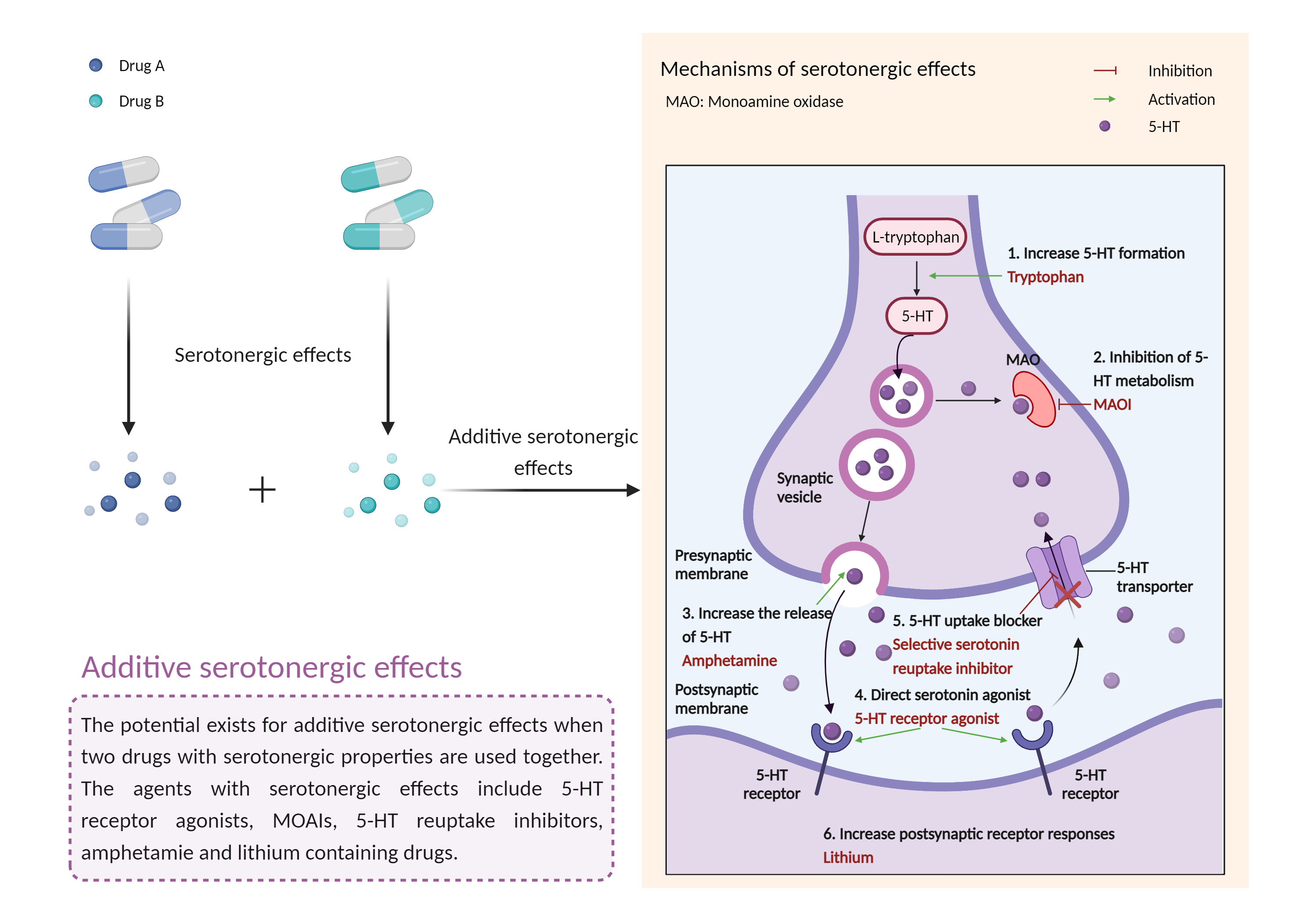
| Additive serotonergic effects Click to Show/Hide Mechanism Graph | |||||||||
 |
|||||||||
| Drug Name | Fentanyl | Methylene blue | |||||||
| Mechanism |
Serotonergic effects Opioid receptor Agonist |
Serotonergic effects Monoamine oxidase non-selective Inhibitor |
|||||||
| Key Mechanism Factor 1 | |||||||||
| Factor Name | Opioid receptor | Structure Sequence | |||||||
| Protein Family | G-protein coupled receptor 1 family | ||||||||
| Protein Function |
Receptor for endogenous opioids such as beta-endorphin and endomorphin. Receptor for natural and synthetic opioids including morphine, heroin, DAMGO, fentanyl, etorphine, buprenorphin and methadone (PubMed:7905839, PubMed:7957926, PubMed:7891175, PubMed:12589820, PubMed:9689128). Agonist binding to the receptor induces coupling to an inactive GDP-bound heterotrimeric G-protein complex and subsequent exchange of GDP for GTP in the G-protein alpha subunit leading to dissociation of the G-protein complex with the free GTP-bound G-protein alpha and the G-protein beta-gamma dimer activating downstream cellular effectors (PubMed:7905839). The agonist- and cell type-specific activity is predominantly coupled to pertussis toxin-sensitive G(i) and G(o) G alpha proteins, GNAI1, GNAI2, GNAI3 and GNAO1 isoforms Alpha-1 and Alpha-2, and to a lesser extent to pertussis toxin-insensitive G alpha proteins GNAZ and GNA15 (PubMed:12068084). They mediate an array of downstream cellular responses, including inhibition of adenylate cyclase activity and both N-type and L-type calcium channels, activation of inward rectifying potassium channels, mitogen-activated protein kinase (MAPK), phospholipase C (PLC), phosphoinositide/protein kinase (PKC), phosphoinositide 3-kinase (PI3K) and regulation of NF-kappa-B. Also couples to adenylate cyclase stimulatory G alpha proteins. The selective temporal coupling to G-proteins and subsequent signaling can be regulated by RGSZ proteins, such as RGS9, RGS17 and RGS4. Phosphorylation by members of the GPRK subfamily of Ser/Thr protein kinases and association with beta-arrestins is involved in short-term receptor desensitization. Beta-arrestins associate with the GPRK-phosphorylated receptor and uncouple it from the G-protein thus terminating signal transduction. The phosphorylated receptor is internalized through endocytosis via clathrin-coated pits which involves beta-arrestins. The activation of the ERK pathway occurs either in a G-protein-dependent or a beta-arrestin-dependent manner and is regulated by agonist-specific receptor phosphorylation. Acts as a class A G-protein coupled receptor (GPCR) which dissociates from beta-arrestin at or near the plasma membrane and undergoes rapid recycling. Receptor down-regulation pathways are varying with the agonist and occur dependent or independent of G-protein coupling. Endogenous ligands induce rapid desensitization, endocytosis and recycling whereas morphine induces only low desensitization and endocytosis. Heterooligomerization with other GPCRs can modulate agonist binding, signaling and trafficking properties. Involved in neurogenesis. Isoform 12 couples to GNAS and is proposed to be involved in excitatory effects (PubMed:20525224). Isoform 16 and isoform 17 do not bind agonists but may act through oligomerization with binding-competent OPRM1 isoforms and reduce their ligand binding activity (PubMed:16580639).
Click to Show/Hide
|
||||||||
| Key Mechanism Factor 2 | |||||||||
| Factor Name | Monoamine oxidase | Structure Sequence | |||||||
| Protein Family | Flavin monoamine oxidase family | ||||||||
| Protein Function |
Catalyzes the oxidative deamination of primary and some secondary amine such as neurotransmitters, with concomitant reduction of oxygen to hydrogen peroxide and has important functions in the metabolism of neuroactive and vasoactive amines in the central nervous system and peripheral tissues (PubMed:20493079, PubMed:8316221, PubMed:18391214, PubMed:24169519). Preferentially oxidizes serotonin (PubMed:20493079, PubMed:24169519). Also catalyzes the oxidative deamination of kynuramine to 3-(2-aminophenyl)-3-oxopropanal that can spontaneously condense to 4-hydroxyquinoline (By similarity).
Click to Show/Hide
|
||||||||
| Mechanism Description |
|
||||||||
| Recommended Action | |||||||||
|---|---|---|---|---|---|---|---|---|---|
| Management | Meperidine and fentanyl should not be used with MAOIs or other agents that possess MAOI activity (e.g., furazolidone, linezolid, methylene blue, procarbazine). Some manufacturers of MAOIs also contraindicate the concomitant use of propoxyphene and methadone due to their possible serotonergic effects. At least 14 days should elapse between discontinuation of MAOI therapy and initiation of treatment with these opioids. Although morphine may also have significant CNS interactions with MAOIs, it is generally considered a safer alternative in patients treated with MAOIs who require a narcotic analgesic. | ||||||||