
Details of Drug-Drug Interaction
| Drug General Information (ID: DDIFD4OU3H) | |||||||||
|---|---|---|---|---|---|---|---|---|---|
| Drug Name | Methadone | Drug Info | Safinamide | Drug Info | |||||
| Drug Type | Small molecule | Small molecule | |||||||
| Therapeutic Class | Analgesics | Dopaminergic Antiparkinsonism Agents | |||||||
| Structure | |||||||||
| Mechanism of Methadone-Safinamide Interaction (Severity Level: Major) | |||||||||
|---|---|---|---|---|---|---|---|---|---|
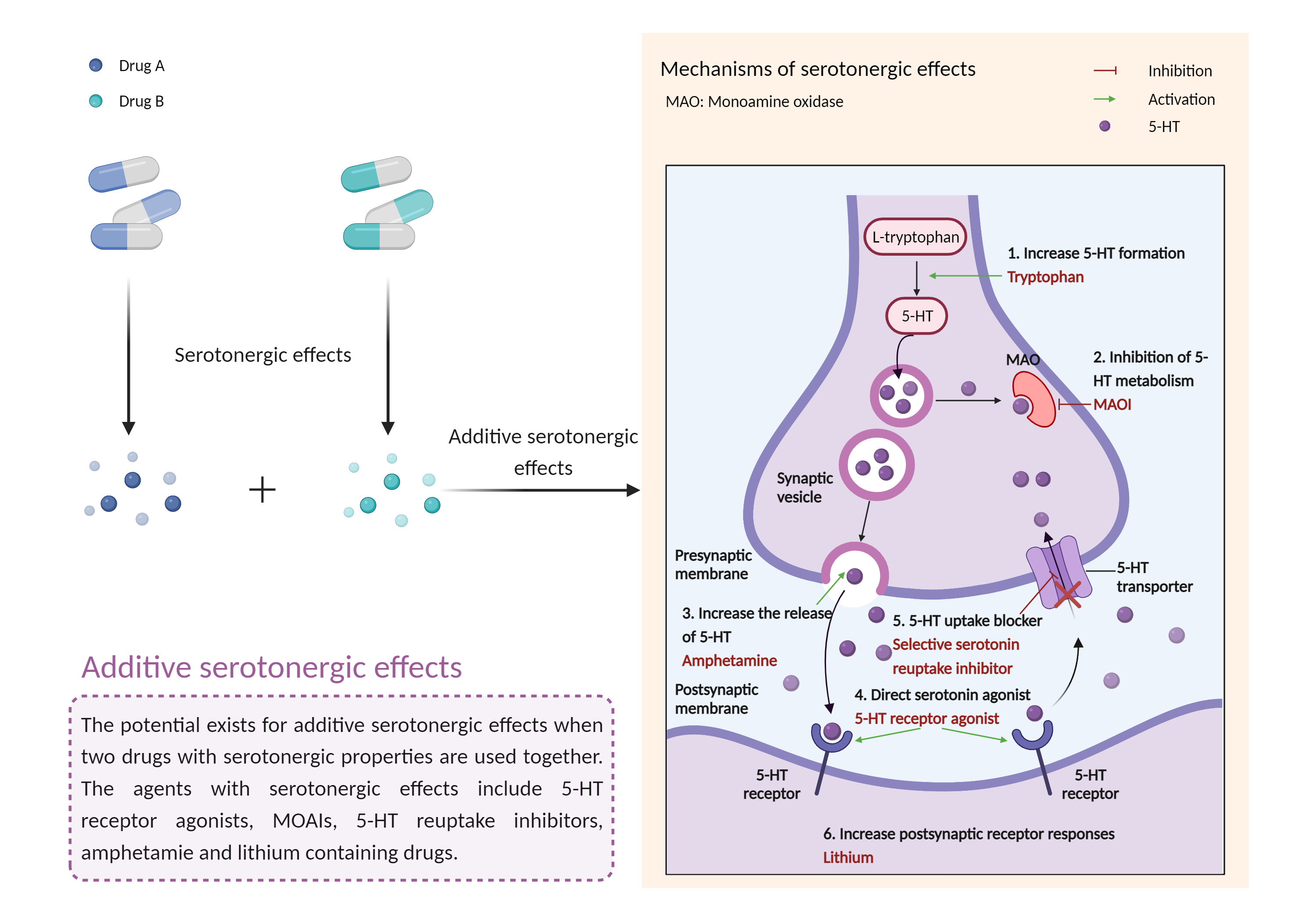
| Additive serotonergic effects Click to Show/Hide Mechanism Graph | |||||||||
 |
|||||||||
| Drug Name | Methadone | Safinamide | |||||||
| Mechanism |
Serotonergic effects 5-HT 3 receptor Antagonist |
Serotonergic effects Monoamine oxidase non-selective Inhibitor |
|||||||
| Key Mechanism Factor 1 | |||||||||
| Factor Name | 5-HT 3 receptor | Structure Sequence | |||||||
| Protein Family | Ligand-gated ion channel (TC 1.A.9) family | ||||||||
| Protein Function |
This is one of the several different receptors for 5-hydroxytryptamine (serotonin), a biogenic hormone that functions as a neurotransmitter, a hormone, and a mitogen. This receptor is a ligand-gated ion channel, which when activated causes fast, depolarizing responses in neurons. It is a cation-specific, but otherwise relatively nonselective, ion channel.
Click to Show/Hide
|
||||||||
| Key Mechanism Factor 2 | |||||||||
| Factor Name | Monoamine oxidase | Structure Sequence | |||||||
| Protein Family | Flavin monoamine oxidase family | ||||||||
| Protein Function |
Catalyzes the oxidative deamination of primary and some secondary amine such as neurotransmitters, with concomitant reduction of oxygen to hydrogen peroxide and has important functions in the metabolism of neuroactive and vasoactive amines in the central nervous system and peripheral tissues (PubMed:20493079, PubMed:8316221, PubMed:18391214, PubMed:24169519). Preferentially oxidizes serotonin (PubMed:20493079, PubMed:24169519). Also catalyzes the oxidative deamination of kynuramine to 3-(2-aminophenyl)-3-oxopropanal that can spontaneously condense to 4-hydroxyquinoline (By similarity).
Click to Show/Hide
|
||||||||
| Mechanism Description |
|
||||||||
| Recommended Action | |||||||||
|---|---|---|---|---|---|---|---|---|---|
| Management | Because the interaction may involve a class-effect of MAOIs, concomitant administration of the selective MAO-B inhibitor, safinamide, with certain opioids such as meperidine, methadone, propoxyphene, and tramadol is considered contraindicated. Some authorities suggest that at least 7 to 14 days should elapse between discontinuation of MAOI therapy and initiation of treatment with opioids. Although morphine may also have significant CNS interactions with MAOIs, it is generally considered a safer alternative in patients treated with MAOIs who require a narcotic analgesic. A sensitivity test should be performed in which repeated, small, incremental doses of morphine are administered over the course of several hours while overall clinical status and vital signs are carefully monitored. | ||||||||