
Details of Drug-Drug Interaction
| Drug General Information (ID: DDIV2SMX5A) | |||||||||
|---|---|---|---|---|---|---|---|---|---|
| Drug Name | Lamotrigine | Drug Info | Phenobarbital | Drug Info | |||||
| Drug Type | Small molecule | Small molecule | |||||||
| Therapeutic Class | Anticonvulsants | Anticonvulsants | |||||||
| Structure | |||||||||
| Mechanism of Lamotrigine-Phenobarbital Interaction (Severity Level: Moderate) | |||||||||
|---|---|---|---|---|---|---|---|---|---|
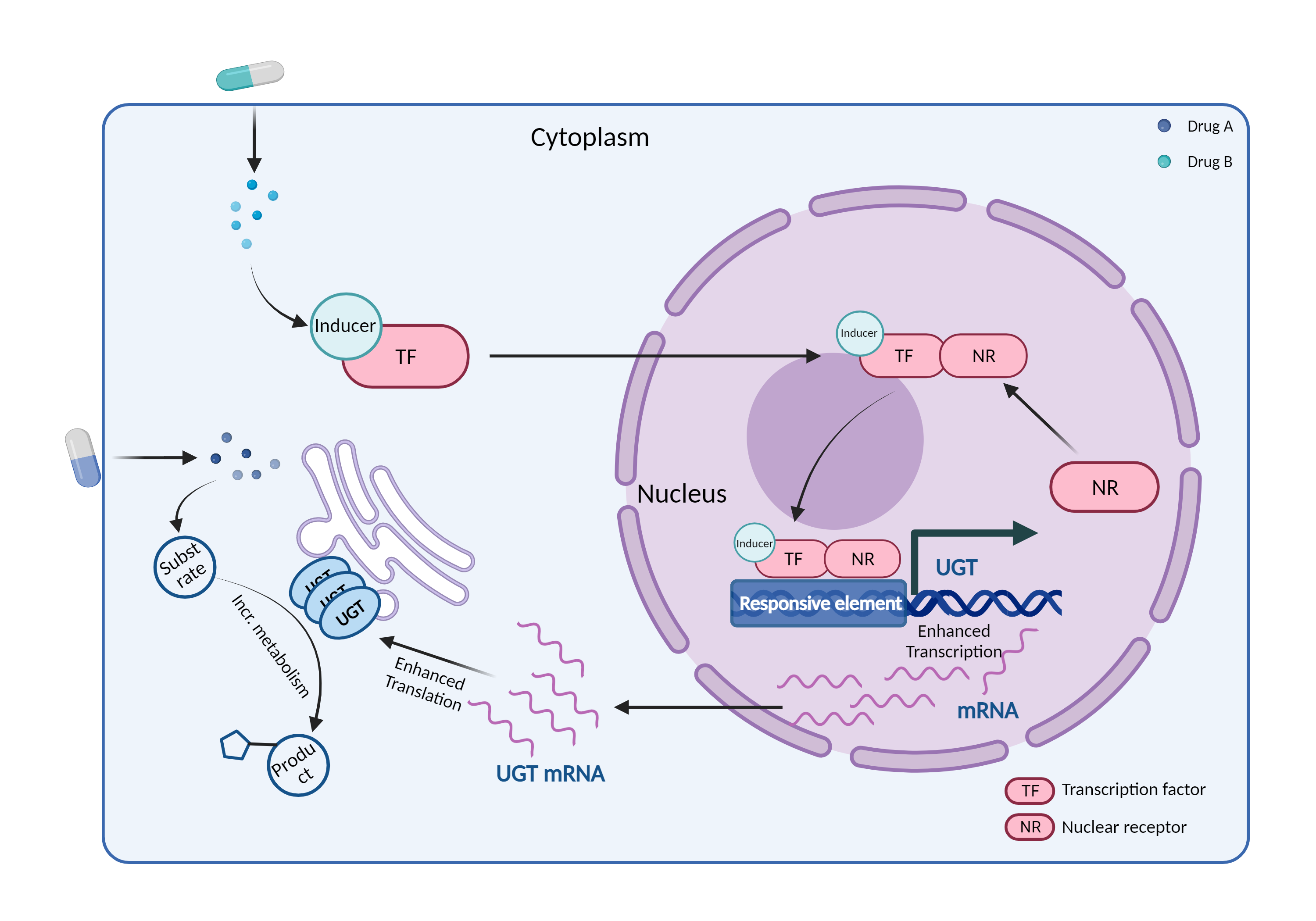
| UGT induction Click to Show/Hide Mechanism Graph | |||||||||
 |
|||||||||
| Drug Name | Lamotrigine | Phenobarbital | |||||||
| Mechanism | UGT substrate | UGT inducer | |||||||
| Key Mechanism Factor 1 | |||||||||
| Factor Name | UDP-glucuronosyltransferase | Structure Sequence | |||||||
| Protein Family | UDP-glycosyltransferase family | ||||||||
| Protein Function |
[Isoform 1]: UDP-glucuronosyltransferase (UGT) that catalyzes phase II biotransformation reactions in which lipophilic substrates are conjugated with glucuronic acid to increase the metabolite's water solubility, thereby facilitating excretion into either the urine or bile (PubMed:12181437, PubMed:15472229, PubMed:18004206, PubMed:18004212, PubMed:18719240, PubMed:19830808, PubMed:23288867). Essential for the elimination and detoxification of drugs, xenobiotics and endogenous compounds (PubMed:12181437, PubMed:18004206, PubMed:18004212). Catalyzes the glucuronidation of endogenous estrogen hormones such as estradiol, estrone and estriol (PubMed:15472229, PubMed:18719240, PubMed:23288867). Involved in the glucuronidation of bilirubin, a degradation product occurring in the normal catabolic pathway that breaks down heme in vertebrates (PubMed:17187418, PubMed:18004206, PubMed:19830808). Also catalyzes the glucuronidation the isoflavones genistein, daidzein, glycitein, formononetin, biochanin A and prunetin, which are phytoestrogens with anticancer and cardiovascular properties (PubMed:18052087, PubMed:19545173). Involved in the glucuronidation of the AGTR1 angiotensin receptor antagonist losartan, a drug which can inhibit the effect of angiotensin II (PubMed:18674515). Involved in the biotransformation of 7-ethyl-10-hydroxycamptothecin (SN-38), the pharmacologically active metabolite of the anticancer drug irinotecan (PubMed:12181437, PubMed:18004212, PubMed:20610558).
Click to Show/Hide
|
||||||||
| Mechanism Description |
|
||||||||
| Recommended Action | |||||||||
|---|---|---|---|---|---|---|---|---|---|
| Management | When lamotrigine is added to existing therapy containing an enzyme-inducing antiepileptic agent without valproate, the initial dosage of lamotrigine should be 0.6 mg/kg/day in two divided doses (2 to 12 years of age) or 50 mg/day (older than 12 years of age) for the first 2 weeks. The initial dosage should be doubled for the next 2 weeks, then increased by 1.2 mg/kg/day or 100 mg/day every 1 to 2 weeks as needed and as tolerated. The usual maintenance dosage is 5 to 15 mg/kg/day (up to 400 mg/day) in children up to 12 years of age and 300 to 500 mg/day (400 mg/day for the treatment of bipolar disorder) in older patients. Patients should be advised to promptly notify their physician if they experience worsening of seizure control or increased adverse effects. A reevaluation of all antiepileptic agents in the regimen should be considered prior to making any changes. If the enzyme-inducing antiepileptic agent is discontinued, lamotrigine half-life will be prolonged and a dosage adjustment may be necessary. Prescribers should refer to the lamotrigine product labeling for complete dosing information. | ||||||||